


How to Choose Redispersible Polymer Powder for Mortar Formulations
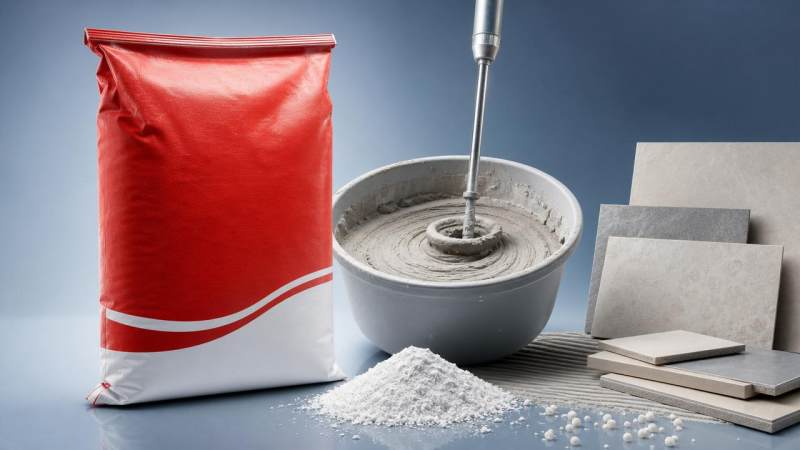
Choosing the right Redispersible Polymer Powder is essential for mortar performance.
The correct grade improves adhesion, flexibility, workability, water resistance, and long-term durability.
A poor match can cause cracking, weak bonding, poor open time, or unstable application behavior.
This guide explains how to evaluate Redispersible Polymer Powder for different mortar formulations and construction requirements.
What is Redispersible Polymer Powder and why does it matter in mortar?
Redispersible Polymer Powder is a spray-dried polymer binder that redistributes in water during mortar mixing.
After curing, it forms a polymer film inside the cementitious matrix.
That film changes the mechanical and application properties of dry-mix mortar.
In practical use, Redispersible Polymer Powder helps mortar resist stress, improve bonding, and remain easier to apply.
It is widely used in tile adhesive, skim coat, repair mortar, self-leveling compounds, EIFS, and exterior insulation systems.
The role of Redispersible Polymer Powder becomes more important when substrates are dense, smooth, absorbent, or thermally unstable.
It also works in synergy with cellulose ethers.
For example, Hydroxypropyl Methyl Cellulose can improve water retention and workability while polymer powder strengthens bonding and flexibility.
Which performance indicators should guide Redispersible Polymer Powder selection?
Selecting Redispersible Polymer Powder starts with the target performance of the mortar, not only the product name.
Different grades are designed to optimize different balance points.
1. Adhesion strength
For tile adhesive and repair mortar, adhesion is often the first screening factor.
A suitable Redispersible Polymer Powder increases bond strength to concrete, brick, cement board, and difficult substrates.
2. Flexibility and crack resistance
Mortars exposed to movement, vibration, or thermal cycles need higher flexibility.
Redispersible Polymer Powder with strong film-forming ability helps absorb stress and reduce brittle failure.
3. Water resistance
Exterior systems, wet areas, and tile applications need stable wet adhesion.
Check whether the selected Redispersible Polymer Powder supports immersion resistance and improved hydrophobic balance.
4. Workability and open time
Application comfort affects jobsite consistency.
Some Redispersible Polymer Powder grades improve spreadability, anti-sag behavior, and open time when paired with proper rheology modifiers.
5. Compressive and tensile balance
Too much softness may reduce mechanical strength in some systems.
The ideal Redispersible Polymer Powder should support flexibility without weakening the designed structural profile.
How do application types influence the best Redispersible Polymer Powder grade?
The same Redispersible Polymer Powder does not fit every mortar formulation.
Application conditions define the correct resin chemistry, dosage, and expected behavior.
Tile adhesive
Tile adhesive requires strong bonding, slip resistance, and good open time.
Choose Redispersible Polymer Powder with reliable adhesion to low-absorption tiles and cement-based substrates.
Skim coat and wall putty
These systems benefit from improved workability, smoothness, and reduced cracking.
A balanced Redispersible Polymer Powder helps surface finish without making the formula unnecessarily expensive.
EIFS and insulation mortars
Exterior insulation systems need weather resistance, flexibility, and impact durability.
In these uses, Redispersible Polymer Powder often plays a central role in preventing debonding and microcracks.
Repair mortar
Repair materials must adhere strongly to aged concrete and resist shrinkage stress.
A higher-performance Redispersible Polymer Powder is usually justified in demanding repair environments.
Self-leveling compounds
These formulas require flow control, surface integrity, and abrasion balance.
The selected Redispersible Polymer Powder should support leveling without harming strength development.
How can you compare Redispersible Polymer Powder grades more accurately?
Product comparison should go beyond price and basic specification sheets.
A more accurate evaluation combines laboratory data, application testing, and formulation compatibility.
Compatibility is equally important.
Redispersible Polymer Powder should work well with cement, fillers, retarders, accelerators, and water-retention additives.
A formulation may perform differently after changing only one additive.
That is why bench testing should always confirm the final choice.
In many mortar systems, pairing polymer powder with Hydroxypropyl Methyl Cellulose helps create a better balance between water retention and application stability.
What common mistakes should be avoided when selecting Redispersible Polymer Powder?
Several selection mistakes can increase cost while reducing formula reliability.
- Choosing only by lowest price, without checking application performance.
- Using a universal Redispersible Polymer Powder for every mortar type.
- Ignoring local climate, substrate condition, and curing environment.
- Assuming higher dosage always means better results.
- Skipping wet adhesion, flexibility, or aging tests.
- Overlooking storage stability and batch consistency.
Excess polymer can sometimes hurt compressive strength or create unnecessary cost pressure.
Insufficient polymer may leave mortar brittle or weakly bonded.
The right Redispersible Polymer Powder selection is always performance-based and dosage-sensitive.
How should you make a final Redispersible Polymer Powder decision?
A practical decision process reduces risk and shortens development time.
- Define the mortar type and target standards.
- List must-have properties such as adhesion, flexibility, or water resistance.
- Shortlist Redispersible Polymer Powder grades by polymer chemistry and technical data.
- Run lab tests with actual cement, sand, fillers, and additives.
- Compare dosage efficiency, performance margin, and total formulation cost.
- Confirm supply stability and batch-to-batch consistency before scale-up.
Reliable supply matters as much as technical fit.
Jinan Ludong Chemical Co., Ltd. provides integrated construction chemical solutions with large-scale production and stable quality control.
Its product range includes HPMC, Redispersible Polymer Powder, and HPS for diverse mortar applications.
Quick FAQ table: how to judge the right Redispersible Polymer Powder
Choosing Redispersible Polymer Powder for mortar formulations requires a clear view of performance goals, application conditions, and additive compatibility.
The best option is not simply the strongest or cheapest grade.
It is the one that delivers stable bonding, workability, durability, and cost efficiency in the final formula.
Start with targeted testing, compare grades carefully, and confirm full-system performance before production scaling.
Send Your Inquiry
We welcome your cooperation and we will develop with you.
