


Redispersible Polymer Powder Cost Trends in 2026
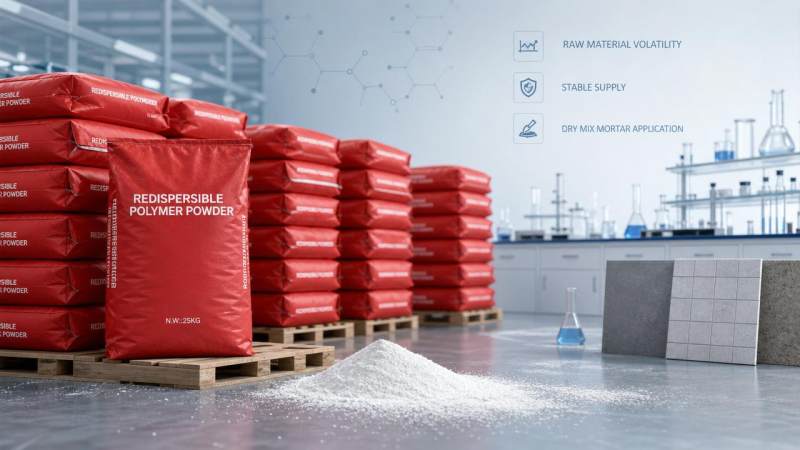
As construction material buyers and commercial evaluators look ahead to 2026, Redispersible Polymer Powder cost trends will be shaped by raw material volatility, supply chain efficiency, and product performance requirements. Understanding these shifts is essential for making informed sourcing decisions, controlling project budgets, and securing stable quality. With integrated manufacturing capabilities and reliable global supply, Ludong Chemical helps customers navigate cost pressures while meeting diverse application needs in modern construction.
What will drive Redispersible Polymer Powder cost trends in 2026?
For 2026 budgeting, Redispersible Polymer Powder cost will not move on resin price alone. Buyers should evaluate monomer costs, energy consumption, logistics, packaging, and specification tightness together, because each factor can shift total landed cost.
In practical terms, commercial evaluators should expect pricing pressure from upstream petrochemical swings, tighter freight schedules, and higher demand for consistent performance in tile adhesives, dry-mix mortars, putties, and repair compounds.
The table shows why a low unit price can still become expensive after shipping, handling, and production losses are added. For project procurement, the real question is not only “what is the price,” but “what is the stable delivered cost for the required grade.”
How should buyers evaluate Redispersible Polymer Powder beyond unit price?
商务评估人员 often face a common problem: two quotations look similar, but one creates higher risk in production. A meaningful comparison should include redispersibility, adhesion, flexibility, water resistance, and compatibility with cement systems and additives.
For purchasing teams, the best approach is to connect product performance with application risk. If the powder underperforms, the hidden cost appears later as rework, rejected batches, or customer complaints.
- Check whether the grade matches the target mortar system, not just the general product category.
- Confirm film formation behavior, because it affects bonding and crack resistance in real use.
- Review moisture control and packaging integrity, especially for long-distance shipping.
- Request consistent test methods so performance comparisons are technically fair.
If your procurement team is also sourcing related starch ethers for formulation support, a solution set such as Hydroxypropyl Starch Ether can help improve workability and texture control in some dry-mix systems. The point is not to buy more materials, but to match functional roles correctly.
Which application scenarios will feel the biggest cost pressure?
Different construction systems react differently to price changes. Tile adhesives tend to need stronger bonding reliability, while exterior insulation and repair mortars often require better flexibility and weather tolerance, which narrows the acceptable formulation window.
These differences matter because a cost-optimized grade in one application may cause higher total expense in another. Commercial evaluators should therefore define the end use first, then compare Redispersible Polymer Powder options by total value, not just by quote.
How does Ludong Chemical support cost control in 2026?
Jinan Ludong Chemical Co., Ltd. combines production, trading, and integrated services in cellulose ethers and related construction materials. This matters for buyers because integrated supply can reduce handoff delays, improve batch continuity, and simplify communication during tight project schedules.
Its production system blends traditional processes with intelligent automation, which supports stable output and flexible order fulfillment. For business evaluation teams, that usually translates into better traceability, clearer delivery planning, and fewer surprises in replenishment cycles.
- Confirm target specification and application scenario before quotation.
- Request sample evaluation and compare working results in your own formula.
- Align packing, lead time, and shipment terms with project schedule.
- Review consistency requirements for repeat orders and multi-site supply.
With an annual capacity of 45,000 tons across key cellulose ether products, Ludong Chemical is positioned to support buyers who need broader construction system coordination, not just a single material quote. That can be especially useful when procurement decisions involve multiple additives and synchronized delivery.
What procurement checklist reduces risk in Redispersible Polymer Powder buying?
A simple checklist helps evaluators avoid incomplete comparisons. Before approving a purchase order, review technical, commercial, and operational details together so that the selected powder fits both production and project needs.
- Define the target formulation and required application performance.
- Confirm test indicators such as adhesion, flexibility, and water resistance.
- Compare moisture-proof packaging and shelf-life handling conditions.
- Ask for batch consistency controls and quality communication procedures.
- Validate lead time, export logistics, and re-order responsiveness.
This checklist is especially useful when budgets are fixed but project performance cannot be compromised. It reduces the risk of choosing a cheaper grade that later increases formulation cost or causes downstream quality issues.
Common misunderstandings about Redispersible Polymer Powder cost
One common misconception is that all powders with similar labels are interchangeable. In practice, dosage level, polymer composition, and compatibility with cement chemistry can change the economics of the entire formulation.
Another mistake is to compare only the ex-factory price. For export or multi-plant buyers, freight, moisture protection, and delivery reliability often have a larger financial impact than a small unit-price difference.
FAQ: What should commercial evaluators ask before approval?
Ask for the formulation target, application case, packing specification, and delivery window. If the supplier cannot explain these clearly, the quote is not yet ready for a serious purchasing decision.
FAQ: Can a lower dose offset a higher powder price?
Sometimes yes, but only if the product delivers equivalent performance at lower dosage. Buyers should verify this through controlled testing, not assumptions based on brochure claims.
FAQ: What evidence matters most in supplier comparison?
Consistency across batches, application feedback, and logistics reliability often matter more than a single lab figure. For Redispersible Polymer Powder, the commercial risk is usually created by variation, not just by price.
2026 outlook: what should buyers do now?
The 2026 outlook suggests moderate pricing uncertainty, but also stronger demand for supply stability and formulation support. Buyers who lock in technical requirements early and compare suppliers on landed cost will be in a better position than those waiting for the lowest quote.
If your team needs help with product selection, performance matching, sample review, or quotation alignment for Redispersible Polymer Powder, Ludong Chemical can discuss application details, packaging preferences, delivery planning, and related construction material coordination. Contact us to confirm parameters, evaluate alternatives, and build a practical sourcing plan for 2026.
Send Your Inquiry
We welcome your cooperation and we will develop with you.
