


Redispersible Polymer Powder in Tile Adhesives: Key Performance Factors
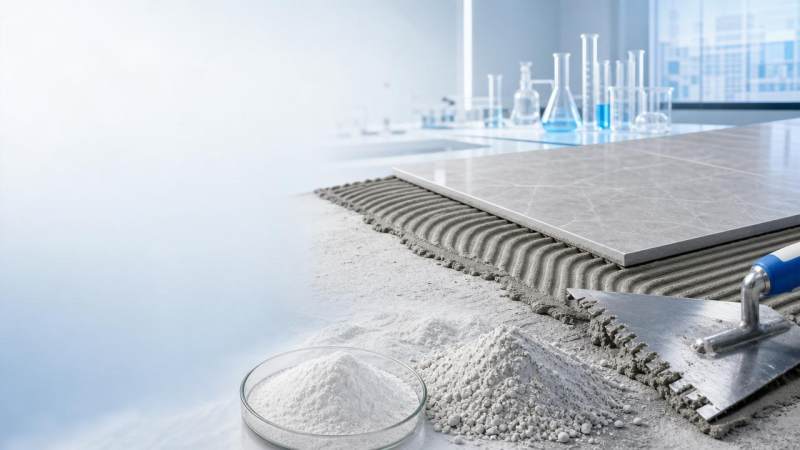
Redispersible Polymer Powder Is Reshaping Tile Adhesive Performance Standards
In tile adhesive formulations, Redispersible Polymer Powder has become a decisive performance driver rather than a minor additive.
As tile sizes increase and substrates diversify, formulation tolerance becomes narrower and quality expectations rise.
Bonding strength alone is no longer enough. Flexibility, open time, slip resistance, and wet durability now define reliable installation performance.
This shift explains why Redispersible Polymer Powder is receiving closer technical evaluation across construction chemistry applications.
For modern dry-mix systems, the right polymer must work with cement hydration, fillers, and cellulose ethers without compromising application efficiency.
Jinan Ludong Chemical Co., Ltd. supports this direction through integrated cellulose ether and polymer solution capabilities for global construction needs.
Performance Expectations Are Moving Beyond Basic Adhesion
The tile adhesive market is changing because installation conditions are more demanding than before.
Large porcelain tiles, low-absorption surfaces, underfloor heating, and exterior exposure all increase stress on the adhesive layer.
Under these conditions, Redispersible Polymer Powder must provide balanced performance instead of improving only one index.
A formulation may show good dry bond strength but still fail if deformation, water exposure, or poor workability are not controlled.
This has pushed technical teams toward multi-factor evaluation, especially for cement-based tile adhesive systems.
Current signals seen in formulation development
- Higher demand for C1 and C2 adhesive consistency across climate conditions.
- Stronger focus on flexibility for thermal movement and substrate vibration.
- Greater interest in water resistance for kitchens, bathrooms, and exterior facades.
- Need for improved application feel during manual and machine-assisted mixing.
- Pressure to optimize cost without sacrificing long-term bonding reliability.
Why Redispersible Polymer Powder Has Such a Strong Influence
After water addition, Redispersible Polymer Powder redistributes into the mortar and forms a polymer film during drying.
That film bridges cement hydrates and fillers, improving cohesion and adhesion at the interface.
It also reduces brittleness, helping the hardened adhesive absorb movement without cracking too easily.
The mechanism looks simple, but performance depends on polymer chemistry, glass transition temperature, protective colloid, and dosage level.
Main drivers behind performance improvement
The Most Important Performance Factors in Tile Adhesive Design
1. Polymer chemistry and glass transition behavior
A softer polymer generally improves flexibility and crack accommodation.
A harder polymer may support mechanical strength but can reduce deformation capacity.
Selection should follow target application, substrate type, and expected thermal or moisture stress.
2. Dosage and cost-performance balance
Redispersible Polymer Powder dosage directly influences bonding, sag resistance, and flexibility.
However, the best result does not always come from the highest addition level.
The target should be the minimum effective dosage that meets final specifications with repeatable production quality.
3. Water resistance and wet adhesion retention
Tile adhesives frequently face moisture, cleaning cycles, or intermittent water exposure.
Redispersible Polymer Powder helps preserve adhesion by improving film integrity and reducing brittle failure after wet aging.
This factor is especially critical for bathrooms, balconies, facades, and renovation projects.
4. Workability and open time control
Application quality depends heavily on spreadability, trowel feel, and the time available for tile placement.
Redispersible Polymer Powder contributes to these properties through water retention interaction and internal cohesion control.
In many systems, it works alongside HPMC and sometimes Hydroxypropyl Starch Ether to refine handling characteristics.
Interaction Effects Now Matter More Than Single-Ingredient Evaluation
One major industry change is the move from isolated raw material testing to system-based formulation analysis.
Redispersible Polymer Powder cannot be judged only by its standalone specification sheet.
Its value appears through interaction with cement type, filler grading, cellulose ether viscosity, and water demand.
A strong polymer in one recipe may underperform in another because the hydration rhythm and rheology profile are different.
Key interaction points to monitor
- Cement reactivity affects early strength and setting behavior.
- Cellulose ether controls water retention, viscosity, and open time.
- Fillers influence packing density and mortar body.
- Water ratio changes dispersion quality and application feel.
- Additive compatibility determines stability during storage and use.
This is why integrated raw material knowledge has growing importance in construction chemicals.
Ludong Chemical’s production base combines cellulose ether expertise with polymer solution support for such multi-variable optimization.
The Impact Extends Across Product Quality, Application Reliability, and Efficiency
Changes in Redispersible Polymer Powder selection influence more than laboratory data.
They affect batch consistency, installer experience, failure risk, and long-term service behavior.
Where the impact becomes visible
What Deserves Close Attention in Future Evaluations
Technical evaluation standards are becoming stricter because end-use demands are rising.
That means Redispersible Polymer Powder should be assessed through realistic application scenarios, not simplified screening alone.
- Test dry, wet, heat-aged, and freeze-thaw related adhesion where relevant.
- Measure open time retention under actual ambient conditions.
- Check deformability for large tile and difficult substrate applications.
- Review interaction with cellulose ether and optional rheology modifiers.
- Compare total formulation economics, not only raw material unit price.
- Track lot-to-lot consistency for long-term production confidence.
In some systems, complementary additives such as Hydroxypropyl Starch Ether may support anti-sag and workability optimization.
A Practical Direction for More Reliable Tile Adhesive Development
The future of tile adhesive design depends on balanced formulation engineering.
Redispersible Polymer Powder will remain central because it connects adhesion, flexibility, durability, and application experience.
The strongest approach is to define target performance first, then match polymer type, dosage, and additive interaction accordingly.
When evaluating systems for current construction demands, focus on whole-formula behavior rather than single-index improvement.
For more stable and efficient construction chemical solutions, it is worth reviewing how Redispersible Polymer Powder performs within complete dry-mix designs and production conditions.
Send Your Inquiry
We welcome your cooperation and we will develop with you.
