


What is the working mechanism of redispersible powder in mortar?
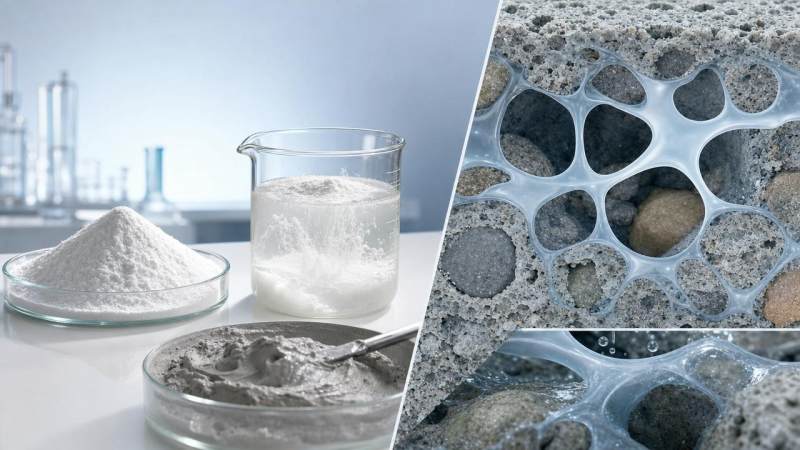
Redispersible Polymer Powder plays a crucial role in modern dry-mix mortar by improving adhesion, flexibility, water resistance, and overall durability after mixing with water.
As mortar hydrates and dries, the powder redisperses into polymer particles that form a continuous film inside the cement matrix.
Understanding this mechanism helps improve tile adhesive, wall putty, repair mortar, skim coat, and insulation system performance.
What Is Redispersible Polymer Powder in Mortar?
Redispersible Polymer Powder is a spray-dried polymer binder designed for dry-mix construction materials.
It usually comes from polymer emulsions based on vinyl acetate, ethylene, acrylate, or similar copolymer systems.
During production, the emulsion is dried into free-flowing powder with protective colloids and anti-caking agents.
When water is added on site, Redispersible Polymer Powder returns to a stable polymer dispersion.
This redispersion ability distinguishes it from ordinary fillers, pigments, or cementitious powders.
In mortar, cement provides mineral strength, while Redispersible Polymer Powder provides organic bonding and deformation resistance.
The result is a hybrid structure combining cement hydration products and polymer film networks.
How Does Redispersible Polymer Powder Work After Water Is Added?
The working mechanism begins during mixing, when water wets cement, sand, fillers, cellulose ether, and polymer powder.
Redispersible Polymer Powder separates into fine polymer particles and spreads through the fresh mortar paste.
Good dispersion helps every part of the mortar receive a similar bonding effect.
Stage 1: Wetting and Redispersion
Water dissolves the protective colloid on each powder particle.
The polymer particles then redisperse and behave similarly to the original emulsion.
This step affects open time, workability, adhesion, and later film formation.
Stage 2: Cement Hydration
Cement reacts with water and forms calcium silicate hydrate, calcium hydroxide, and other hydration products.
These mineral crystals create compressive strength and early structural stability.
Redispersible Polymer Powder does not replace cement hydration; it complements the mineral framework.
Stage 3: Particle Packing and Coalescence
As water evaporates or is consumed by hydration, polymer particles move closer together.
They deform, coalesce, and gradually form a continuous or semi-continuous film.
This film bridges pores, aggregates, cement hydrates, and substrate surfaces.
Stage 4: Final Polymer-Cement Network
After curing, the mortar contains both rigid mineral crystals and flexible polymer domains.
This combined network improves tensile adhesion, flexural strength, impact resistance, and resistance to microcracking.
For this reason, Redispersible Polymer Powder is essential in many high-performance mortar formulas.
Why Does Redispersible Polymer Powder Improve Adhesion?
Adhesion is one of the most important benefits of Redispersible Polymer Powder in cement-based mortar.
The polymer film improves contact between mortar and substrates such as concrete, brick, tile, gypsum board, and insulation panels.
It fills small surface irregularities and increases the effective bonding area.
In tile adhesive, this mechanism helps resist shear stress, thermal movement, and long-term vibration.
In wall putty, it helps reduce powdering and improves the bond between layers.
In repair mortar, it supports stronger contact with old concrete surfaces.
Adhesion depends on polymer type, dosage, cement quality, sand grading, water demand, and curing conditions.
A balanced formula often combines Redispersible Polymer Powder with cellulose ether for better water retention and workability.
For example, Methyl Hydroxyethyl Cellulose (HEMC) can help control consistency and water retention in dry-mix systems.
How Does It Reduce Cracking and Improve Flexibility?
Cement mortar is naturally strong under compression but weaker under tension and movement.
Shrinkage, temperature changes, substrate movement, and drying stress may cause cracks.
Redispersible Polymer Powder improves flexibility by creating elastic bridges inside the hardened mortar.
These bridges help distribute stress before cracks become visible or spread.
The polymer phase also improves cohesion, making the mortar less brittle after curing.
This is important in exterior insulation finishing systems, flexible tile adhesive, waterproof mortar, and crack-resistant putty.
However, too much Redispersible Polymer Powder may reduce stiffness or increase cost unnecessarily.
The correct dosage should match the expected movement, substrate type, and performance standard.
Where Is Redispersible Polymer Powder Most Commonly Used?
Redispersible Polymer Powder is used where dry mortar needs stronger bonding, better toughness, or improved water resistance.
Different applications require different polymer grades, glass transition temperatures, and formulation support.
- Tile adhesive: improves tensile adhesion, slip resistance, and durability under temperature changes.
- Wall putty: increases surface strength, sanding balance, and layer-to-layer adhesion.
- Repair mortar: enhances bonding to old concrete and reduces brittle failure.
- Skim coat: improves cohesion, workability, and resistance to surface powdering.
- EIFS mortar: supports flexibility, adhesion to insulation boards, and weather resistance.
- Self-leveling mortar: helps control cohesion and surface integrity when properly formulated.
For each use, Redispersible Polymer Powder should be evaluated with cement, fillers, cellulose ether, defoamer, and setting regulators.
Laboratory testing is important because one additive cannot correct every raw material imbalance.
How to Choose the Right Redispersible Polymer Powder Grade?
Choosing Redispersible Polymer Powder requires more than comparing price or appearance.
The grade should match the mortar’s mechanical, environmental, and application requirements.
A reliable supplier should provide technical data, application recommendations, and stable batch quality.
Jinan Ludong Chemical Co., Ltd. focuses on cellulose ethers and construction additives for dry-mix mortar solutions.
Its portfolio includes HPMC, Redispersible Polymer Powder, HPS, and related support for construction chemical systems.
What Mistakes Should Be Avoided in Mortar Formulation?
Several formulation mistakes can reduce the value of Redispersible Polymer Powder.
The first mistake is using dosage alone as the main performance guarantee.
Higher dosage does not always mean better mortar, especially when cement or sand quality is unstable.
The second mistake is ignoring water retention and open time.
If water escapes too quickly, cement hydration and polymer film formation may both suffer.
Cellulose ether selection is therefore closely connected with polymer powder performance.
The third mistake is testing only early strength while ignoring long-term durability.
Mortar should be checked after dry curing, wet curing, heat aging, or freeze-thaw exposure when relevant.
The fourth mistake is choosing a grade without considering local climate.
Low temperature, high humidity, or strong sun exposure can influence film formation and curing balance.
FAQ: Redispersible Polymer Powder Mechanism and Use
How Should Performance Be Tested Before Production?
Before full production, Redispersible Polymer Powder should be tested in the complete mortar formula.
Small paste tests can check dispersion, viscosity, air entrainment, and initial workability.
Mortar tests should measure tensile adhesion, flexural strength, compressive strength, water absorption, and open time.
Application trials should also check troweling, sag resistance, surface finish, sanding, and setting behavior.
For demanding applications, aging tests help predict field durability.
If mortar shows poor adhesion, adjust polymer grade, cellulose ether, sand grading, or water demand systematically.
Changing many components at once makes troubleshooting difficult.
Summary: Why the Mechanism Matters
Redispersible Polymer Powder works through redispersion, cement hydration support, particle coalescence, and final polymer film formation.
This mechanism improves adhesion, flexibility, cohesion, water resistance, and long-term mortar durability.
The best results come from matching the polymer grade with the target application and full formulation system.
When combined with suitable cellulose ethers, such as Methyl Hydroxyethyl Cellulose (HEMC), mortar can achieve better consistency and curing balance.
For practical formulation, compare technical data, run controlled trials, and verify performance under realistic jobsite conditions.
Jinan Ludong Chemical provides integrated construction chemical solutions, supporting stable dry-mix mortar performance from raw material selection to application optimization.
Send Your Inquiry
We welcome your cooperation and we will develop with you.
