


How to Prevent Foaming With Water-Soluble HPMC
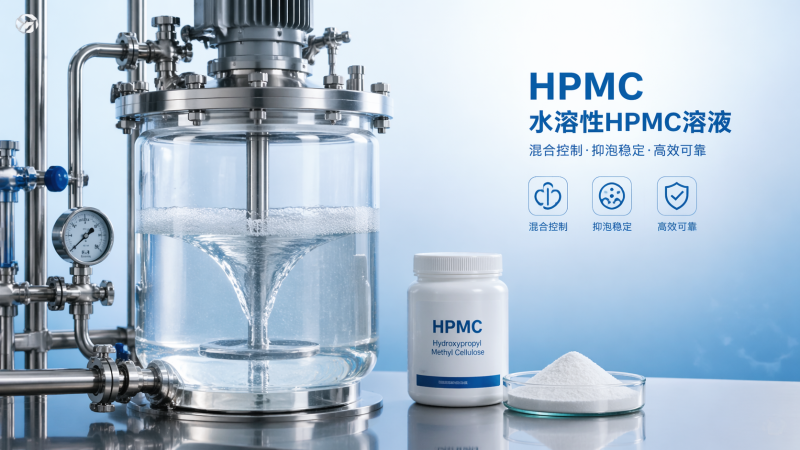
Foaming in HYDROXYPROPYL METHYL CELLULOSE water-soluble systems can affect mixing efficiency, surface finish, and final product stability. For technical evaluators, buyers, and quality managers, understanding how to control foam is essential when selecting a reliable HYDROXYPROPYL METHYL CELLULOSE supplier. This guide explains the main causes of foaming, practical prevention methods, and how high-performance cellulose ethers support more consistent industrial results.
Why Does Water-Soluble HPMC Foam During Mixing?
Foam in water-soluble HPMC systems usually comes from a combination of material behavior, mixing energy, and formulation design. HPMC acts as a thickener, film former, and water-retention agent, but these same properties can also stabilize air bubbles once they enter the liquid phase. In practical production, even a well-selected grade may generate visible foam if the wetting sequence, agitation speed, or additive compatibility is not controlled within a reasonable operating window.
For chemical manufacturers and downstream users, the problem often appears in 3 stages: powder wetting, dissolution, and final homogenization. During initial charging, dry powder can trap air on the particle surface. During dissolution, viscosity rises and slows bubble release. In the final mixing stage, high-shear equipment may continuously entrain new air. This is why foaming is not only a raw material issue, but also a process issue tied to equipment, temperature, and operator practice.
Technical evaluators should also distinguish between temporary foam and persistent foam. Temporary foam may disappear after 10–30 minutes of standing, while persistent foam remains through pumping, filling, or coating application. Persistent foam is more likely to affect mortar smoothness, coating appearance, or slurry stability. For procurement teams, this distinction matters because it helps define whether the solution lies in selecting a different HPMC grade, adjusting process parameters, or adding a compatible defoaming strategy.
Another practical point is that water quality and batch consistency can change results. Variations in pH, dissolved salts, and process temperature, such as 10°C–25°C versus warmer plant conditions, may influence hydration speed and foam persistence. In large-volume production, these differences become more visible because residence time, tank geometry, and recirculation intensity all amplify small formulation weaknesses.
Main foaming triggers in industrial use
- Excessive agitation speed or long mixing time, especially when high shear is maintained after full dissolution.
- Poor powder addition sequence, causing floating agglomerates and trapped air during wetting.
- Viscosity selection mismatch, where an overly high CPS range slows deaeration in the target application.
- Incompatibility with surfactants, dispersants, or other surface-active additives already present in the formula.
How to Prevent Foaming With Water-Soluble HPMC in Real Production
The most effective way to prevent foaming with water-soluble HPMC is to control both formulation and process conditions instead of relying on a single corrective action. In most plants, 4 core levers should be reviewed first: powder feeding method, water temperature, mixing intensity, and additive sequence. If these are optimized early, the need for heavy defoamer use usually drops, which helps preserve application performance and long-term stability.
A common best practice is to avoid dumping HPMC directly into fast-rotating water. Gradual dosing under moderate agitation allows particles to wet more evenly and reduces surface air capture. Many operators also prefer a two-step hydration approach: initial dispersion under controlled agitation, followed by a holding period for complete dissolution. Depending on grade and system design, a 20–40 minute maturation period can significantly reduce residual foam and undissolved microgels.
Temperature management is another overlooked factor. Very cold water can slow hydration, while excessive process heat may change viscosity build and additive behavior. In many industrial scenarios, a stable preparation environment within a moderate range supports more repeatable results. Quality teams should document not only final viscosity, but also appearance, foam height, and bubble break time at fixed intervals such as 5, 15, and 30 minutes after mixing.
When formulation complexity increases, supplier support becomes more valuable. A manufacturer with broad viscosity control, such as 400 to 200,000 CPS, can help narrow down grades that balance workability and deaeration. This is especially relevant in drymix construction systems, chemical-grade solutions, and multi-additive formulations where one small adjustment may influence water retention, sag resistance, and foam behavior at the same time.
A practical 5-step anti-foam workflow
- Verify the target viscosity range and end-use requirement before production-scale charging.
- Add powder slowly into the vortex edge rather than the center of aggressive shear.
- Use moderate agitation during wetting, then reduce speed after initial dispersion.
- Allow 20–40 minutes for hydration and bubble release before final property adjustment.
- Introduce defoamers only after compatibility screening with the full formulation.
What quality teams should monitor
Quality control should not evaluate foaming only by visual observation at one time point. A more useful routine includes at least 5 checks: wetting speed, dissolution uniformity, foam height immediately after mixing, foam decay over time, and effect on the final surface or application layer. This approach helps separate a process upset from a raw material selection issue and supports faster corrective action.
Which HPMC Selection Factors Matter Most for Buyers and Technical Evaluators?
For buyers, preventing foam starts before the first batch is made. HPMC grade selection should match the application system, target viscosity, mixing method, and downstream performance requirement. In procurement reviews, 3 questions are essential: what viscosity range is required, how sensitive is the formulation to entrained air, and what level of technical support is needed during trial production. These questions reduce the risk of choosing a grade only by price or generic specification sheet language.
Jinan Ludong Chemical Co., Ltd. operates as a large-scale cellulose ether manufacturer integrating production, trading, and service support. For decision-makers, that matters because supply capability and grade consistency influence foaming control just as much as lab performance. With annual capacity reaching 45,000 tons and HPMC viscosity controllable from 400 to 200,000 CPS, the company can support different construction and chemical-grade requirements without forcing customers into a narrow product window.
Technical evaluators should also review whether the supplier can support trial-to-scale transition. A grade that behaves well in a 5-liter lab mixer may act differently in a 500-liter or 2,000-liter vessel. The supplier should be able to discuss powder dispersion behavior, recommended charging sequence, and compatibility with common additives. In some drymix or modified systems, pairing HPMC with materials such as Redispersible Polymer Powder also changes air management and film formation behavior, so coordinated selection becomes important.
Procurement teams should also look beyond headline viscosity and ask for repeatability indicators tied to application. Batch-to-batch uniformity, moisture control, packaging integrity, and lead-time visibility all affect plant stability. In B2B purchasing, a short-term price gain can be erased quickly if foaming leads to rework, unstable appearance, or extra defoamer cost across multiple production cycles.
Supplier evaluation table for anti-foam performance
The table below helps procurement, R&D, and quality teams compare water-soluble HPMC suppliers using selection factors directly linked to foaming risk, scale-up stability, and purchasing efficiency.
This evaluation structure is especially useful when comparing 2–3 qualified suppliers. It shifts the discussion from simple unit price to total process stability, which is usually the better indicator of long-term purchasing value in chemical production.
How Do Process Settings, Additives, and Cost Choices Compare?
In many plants, foam is treated with extra defoamer before the team reviews root cause. That approach may work in the short term, but it can also increase formulation cost and introduce side effects such as crater formation, reduced compatibility, or altered surface finish. A better decision path compares process optimization, HPMC grade adjustment, and additive correction side by side. This is especially important when batches run weekly, daily, or continuously across multiple product lines.
From a cost perspective, the lowest-priced HPMC is not always the lowest-cost option. If one grade requires longer mixing time, higher defoamer dosage, or more rejected batches, the total operating cost rises. Buyers should calculate impact over a typical 1–3 month purchasing cycle, not only on delivered material price. This broader view is more aligned with the concerns of plant managers and finance-focused decision-makers.
There are also formulation cases where air control interacts with other performance additives. For example, film-forming systems or modified drymix products may need a balanced approach between rheology, adhesion, and foam suppression. In such systems, the compatibility of HPMC with additives like Redispersible Polymer Powder should be checked during pilot testing rather than assumed from single-material data.
A useful internal review is to compare 3 routes: process tuning only, material change only, or combined optimization. In many cases, combined optimization delivers the best balance because it reduces foam without sacrificing retention, consistency, or application feel. That is why cross-functional review between procurement, production, and QC is often more effective than isolated corrective action.
Comparison of common anti-foam approaches
The following table compares typical anti-foam strategies used with water-soluble HPMC, including their operational impact and purchasing implications.
For most B2B users, the most economical path is to standardize charging and mixing first, then confirm whether a grade adjustment is necessary. Defoamer should usually be the third lever, not the first, unless the formulation already depends on it for broader surface control.
What Are the Most Common Misconceptions and Quality Risks?
One common misconception is that all foam means poor HPMC quality. In reality, foaming often results from the interaction of HPMC with mixers, surfactants, fillers, pigments, or process timing. Another mistaken assumption is that higher viscosity always means better performance. In some systems, a higher-viscosity grade improves suspension or water retention but also slows bubble escape, creating a trade-off that must be evaluated at the formulation level.
A second risk is evaluating the material only in a small beaker test. Small-scale screening is useful, but it can underestimate air entrainment seen in production tanks. A more reliable validation path uses at least 2 stages: lab screening and pilot verification. If the application is highly sensitive, a third stage with production-equivalent shear and batch size is recommended before approving routine purchase.
Quality and safety managers should also consider storage and handling. Moisture exposure, damaged packaging, or inconsistent feeding conditions can change powder flow and dispersion behavior. These variables do not always change a standard certificate result, but they may still change real-world foam response. That is why receiving inspection and controlled storage conditions are part of anti-foam management, not separate tasks.
Finally, many teams focus on foam height but ignore final-use impact. A batch with moderate visible foam may still perform acceptably if bubbles break before application. By contrast, a batch with lower apparent foam may leave microbubbles that damage smoothness or coating continuity. The decision criterion should therefore be end-use effect, not visual appearance alone.
FAQ for technical review and purchasing teams
How should we test water-soluble HPMC for foam risk before purchasing?
Use a 2-step evaluation. First, run a lab screening with fixed water quality, controlled temperature, and defined mixing time. Second, confirm in a pilot batch that reflects actual tank geometry and agitation. Record at least 5 items: wetting time, dissolution appearance, initial foam, foam decay, and end-use surface result. This gives procurement teams a more reliable basis than price and viscosity data alone.
Is lower-foam HPMC always the right choice?
Not necessarily. The right choice is the grade that fits the total formula. A lower-foam option may change water retention, open time, or application feel. Selection should balance 3 targets: processability, final performance, and cost control. This is why application-specific sampling is important, especially in construction chemicals and chemical-grade systems.
What delivery and support questions should B2B buyers ask suppliers?
Ask about standard lead time, packaging options, viscosity range, sample support, and trial guidance. Also confirm whether the supplier can help troubleshoot during the first 1–2 production runs. For large-volume users, it is useful to discuss batch reservation, documentation needs, and whether the supplier can support different grades for parallel applications.
Why Choose a Scalable Cellulose Ether Partner for Foam Control?
When foam affects efficiency and product consistency, the real requirement is not only a material quotation. It is a supplier that can align grade selection, process advice, and stable supply. Jinan Ludong Chemical Co., Ltd. combines cellulose ether manufacturing, trading, and integrated service support, helping customers evaluate HPMC for construction and chemical-grade applications under practical production conditions rather than isolated lab assumptions.
Its production system combines traditional process knowledge with intelligent automated production, which is useful for customers who value repeatability across ongoing orders. With annual capacity of 45,000 tons and HPMC viscosity control from 400 to 200,000 CPS, the company is positioned to support different project sizes, from trial-stage qualification to larger procurement programs. This matters when buyers need continuity across sample approval, pilot testing, and routine delivery.
If your team is reviewing how to prevent foaming with water-soluble HPMC, the most efficient next step is a focused technical discussion. You can confirm viscosity targets, mixing sequence, application conditions, packaging needs, and expected delivery cycle before placing volume orders. This shortens evaluation time and reduces the risk of choosing a grade that performs well on paper but creates instability in production.
Contact us to discuss sample support, parameter confirmation, HPMC grade selection, compatibility with your current additives, delivery planning, and quotation details. For procurement teams, this means clearer cost comparison. For technical evaluators and QC managers, it means a more controlled path from testing to stable industrial use.
Send Your Inquiry
We welcome your cooperation and we will develop with you.
