


Hydroxypropyl Methyl Cellulose Trends in 2026 Building Materials
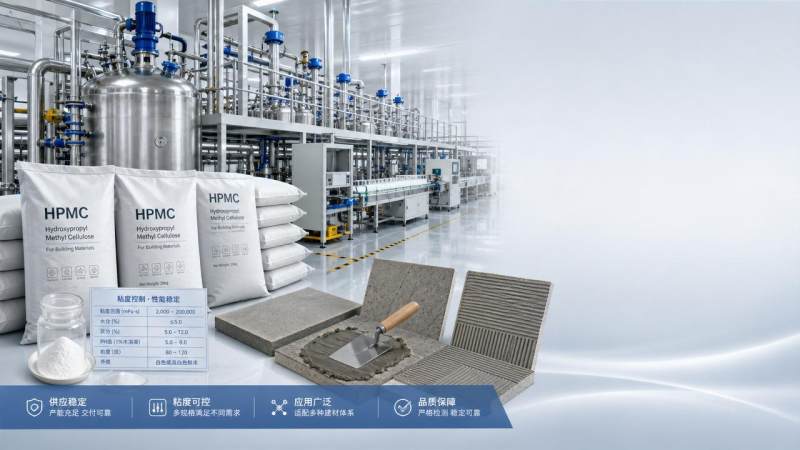
In 2026, HYDROXYPROPYL METHYL CELLULOSE is set to play a bigger role in building materials as manufacturers and project leaders prioritize performance, consistency, and cost efficiency. For business decision-makers, understanding market trends, supply capabilities, and application innovation is essential to choosing reliable partners and staying competitive in a fast-evolving construction chemicals landscape.
For procurement leaders, plant managers, and formulation teams, the question is no longer whether HYDROXYPROPYL METHYL CELLULOSE matters, but how to secure the right grade, viscosity range, and supplier support for large-volume projects. In drymix mortar, tile adhesive, skim coat, self-leveling compounds, and EIFS systems, even small changes in cellulose ether performance can affect water retention, open time, anti-sag behavior, workability, and final application consistency.
In 2026, buying decisions will increasingly depend on 4 practical factors: production stability, viscosity control, delivery reliability, and technical matching by application. Companies that evaluate these dimensions early can reduce reformulation cycles, avoid batch-to-batch variation, and improve cost control across multi-site construction material operations.
Why HYDROXYPROPYL METHYL CELLULOSE Will Gain More Strategic Importance in 2026
The role of HYDROXYPROPYL METHYL CELLULOSE in building materials has evolved from a basic additive to a formulation-critical component. In many mortar systems, dosage may only range from 0.2% to 0.8%, yet its effect on water retention, rheology, and application comfort is disproportionately high. That makes supplier selection a strategic purchasing decision rather than a routine commodity purchase.
Demand Is Rising Across More Formulation Types
Construction chemical manufacturers are broadening their product portfolios to serve regional climates, substrate conditions, and labor preferences. As a result, HYDROXYPROPYL METHYL CELLULOSE is being specified not only for tile adhesive and wall putty, but also for repair mortars, gypsum-based products, insulation systems, and machine-applied mixes.
This expansion increases the need for differentiated viscosity options such as 400 CPS to 200,000 CPS, along with tighter control over moisture, substitution consistency, and dissolution behavior. For enterprise buyers, wider application use means more technical checkpoints during supplier qualification.
Performance Expectations Are Becoming More Specific
In 2026, customers are less satisfied with broad claims like “good workability.” They increasingly request measurable targets such as open time extension by 10 to 20 minutes, reduced tile slip under vertical application, or smoother troweling under high-temperature conditions above 30°C. This trend pushes HPMC procurement toward application-based specifications instead of generic grade selection.
The table below outlines how HYDROXYPROPYL METHYL CELLULOSE supports different building material segments and why decision-makers should map product grades to end-use requirements before scaling production.
The key takeaway is that the same additive family serves multiple systems, but the purchasing logic is not identical. Business buyers should expect at least 3 layers of review: formulation fit, process fit, and supply fit. A supplier that performs well in one product line may still require validation for another.
Supply Security Is Now a Competitive Advantage
As construction chemicals production becomes more regionally distributed, supply continuity matters as much as product specification. Jinan Ludong Chemical Co., Ltd., established in 2020, operates as a large-scale global manufacturing enterprise focused on cellulose ethers, production, trading, and integrated services. Its annual production capacity reaches 45,000 tons, covering HPMC series such as type 75 and type 60 for construction and chemical grades.
For enterprise customers, that scale matters because it supports structured supply planning, especially for recurring orders with viscosity requirements ranging from 400 to 200,000 CPS. In practical terms, a supplier with comprehensive production lines and integrated solutions is often better equipped to support both standard procurement and customized formulation adjustment.
How Decision-Makers Should Evaluate HPMC Suppliers and Product Fit
Purchasing HYDROXYPROPYL METHYL CELLULOSE for building materials should follow a structured process rather than a price-only comparison. A low-cost grade that causes poor dispersion, unstable open time, or inconsistent water retention can create hidden costs through complaints, rework, and slower production throughput. In most cases, 5 to 7 evaluation items are enough to identify major supply risks before commercial commitment.
Five Critical Evaluation Dimensions
A practical HPMC sourcing framework should include technical suitability, consistency between lots, capacity reliability, response speed, and formulation support. These factors directly affect operating stability in drymix mortar production and influence whether a supplier can support scale-up from trial batches to container-level shipments.
- Viscosity match for the target application, such as low, medium, or high CPS requirements.
- Water retention performance under site-specific temperature and humidity conditions.
- Batch consistency across at least 3 trial lots before annual contracting.
- Lead time reliability, especially for repeat orders within 7 to 21 days.
- Technical communication efficiency during sample adjustment and complaint handling.
Why Viscosity Alone Is Not Enough
Two products with similar nominal viscosity may behave differently in real formulations due to differences in particle distribution, thermal gel characteristics, surface treatment, or dissolution speed. That is why laboratory comparison should include at least 4 checkpoints: mixing time, slump or sag response, open time, and substrate feel during manual application.
In some projects, buyers also compare HYDROXYPROPYL METHYL CELLULOSE with adjacent cellulose ether options for specific climate or substrate demands. For example, Methyl Hydroxyethyl Cellulose (HEMC) may enter technical discussions where water retention profile, workability response, or temperature adaptation needs a different balance.
The following table can help purchasing teams convert technical evaluation into a decision-ready checklist that procurement, R&D, and operations can review together.
This checklist helps move the discussion beyond unit price. For most manufacturers, the total cost of ownership includes product stability, formulation efficiency, complaint reduction, and planning confidence. A technically aligned supplier often creates more value than a nominally cheaper source.
What to Ask Before Signing a Supply Agreement
Before converting trials into regular procurement, decision-makers should clarify 6 practical points: available grades, viscosity tolerance, packaging options, standard lead time, complaint response workflow, and support for formulation adjustment. These questions help define whether the supplier is ready for long-term collaboration or only suitable for spot purchasing.
- Can the supplier support multiple construction grades under one purchasing plan?
- Is viscosity controllable within a range appropriate for repeat production?
- How quickly can additional samples or adjusted grades be delivered?
- What documentation is available for technical review and quality confirmation?
- Can the supplier coordinate with RDP, HPS, or related drymix system needs?
Application Innovation, Cost Pressure, and Formulation Trends for 2026
The next phase of HYDROXYPROPYL METHYL CELLULOSE demand will be shaped by two forces at the same time: tighter cost control and higher application expectations. Building material producers are under pressure to optimize formula economics without sacrificing jobsite performance. That means additive selection in 2026 will focus on efficiency per kilogram, not just purchase price per ton.
Formulation Efficiency Will Be Measured More Carefully
Manufacturers are increasingly testing how HYDROXYPROPYL METHYL CELLULOSE performs in combination with redispersible polymer powder, starch ether, and mineral fillers. In many systems, a small shift in additive balance can improve troweling feel, reduce water demand, or stabilize construction behavior across different cement lots. These gains may appear small in the lab but become meaningful at 1,000-ton or 5,000-ton annual product volume.
This is where integrated suppliers can add value. Ludong Chemical’s portfolio includes HPMC, RDP, and HPS, allowing buyers to discuss formulation compatibility from a broader system perspective. For companies developing or upgrading drymix product lines, this can shorten coordination time between purchasing and technical teams.
Automation and Production Consistency Matter More Than Ever
As construction chemical plants move toward automated feeding, dosing, and blending, consistency requirements become stricter. Variability that might have been tolerated in a manual or low-speed environment can cause more visible problems in automated production. Suppliers with a combination of traditional process know-how and intelligent automated production are better positioned to deliver stable quality over repeated order cycles.
For example, if a producer runs 2 to 3 production shifts per day, even minor variation in cellulose ether dissolution or bulk density can influence mixing time, line rhythm, and operator adjustments. Over a quarter, these inefficiencies may become more expensive than the initial material price difference.
Risk Control in Global and Regional Procurement
In 2026, procurement teams should prepare for fluctuations in freight schedules, peak-season lead times, and project-driven demand spikes. A robust sourcing strategy often includes 3 steps: validate core grades in advance, maintain safety stock for critical SKUs, and align forecast windows with supplier production planning. This approach reduces disruption risk without overcommitting inventory.
Where technical alternatives are being assessed, teams may also compare solutions such as Methyl Hydroxyethyl Cellulose (HEMC) for selected applications. The goal is not to switch blindly, but to create a clearer decision matrix for climate conditions, formula type, and commercial targets.
Common Buying Mistakes to Avoid
Several recurring mistakes increase procurement risk. The first is choosing only by headline viscosity without testing application behavior. The second is approving samples without confirming scale consistency. The third is failing to connect commercial terms with technical service expectations. Any one of these gaps can delay launches by 2 to 6 weeks.
Another common issue is underestimating customer-specific adaptation. A grade that performs well in one region may need adjustment in areas with faster water evaporation, different sand grading, or distinct installer habits. That is why regional trials and practical feedback remain essential, even when lab data looks acceptable.
A Practical Sourcing Outlook for Business Leaders
HYDROXYPROPYL METHYL CELLULOSE will remain a core functional material in 2026 building materials, but procurement success will depend on more disciplined evaluation. The strongest purchasing decisions will balance 3 priorities: technical performance, supply assurance, and long-term formulation efficiency. For companies serving demanding construction markets, this balance is what protects margin and product reputation.
Jinan Ludong Chemical Co., Ltd. brings a relevant profile for this market environment through large-scale cellulose ether manufacturing, integrated construction solutions, and annual capacity of 45,000 tons. With HPMC construction and chemical grades, viscosity control from 400 to 200,000 CPS, and a portfolio that also includes RDP and HPS, the company is positioned to support buyers seeking both volume reliability and technical coordination.
If you are reviewing suppliers, upgrading mortar formulations, or planning 2026 procurement for drymix systems, now is the right time to compare grade options, validate performance targets, and build a more resilient supply plan. Contact us to discuss your application requirements, request a tailored recommendation, or learn more about practical cellulose ether solutions for building materials.
Send Your Inquiry
We welcome your cooperation and we will develop with you.
