


Key Applications of RDP in the Dry-Mix Mortar Industry
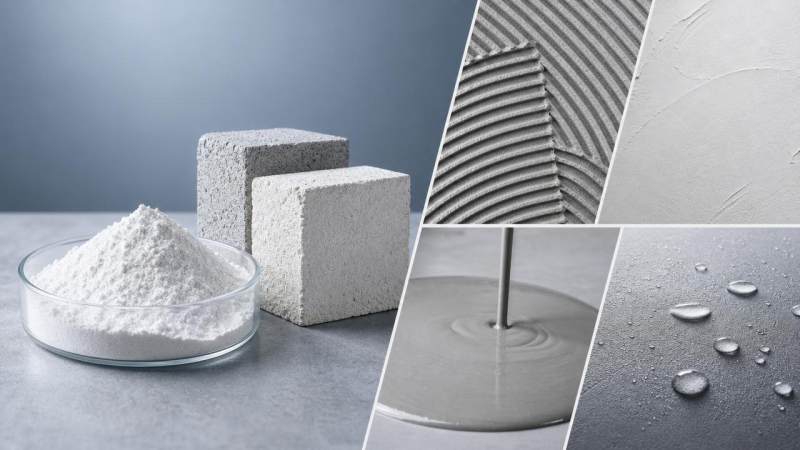
In the dry-mix mortar industry, performance, consistency, and workability define whether a formulation can meet modern construction standards.
Redispersible Polymer Powder improves adhesion, flexibility, water resistance, and durability across tile adhesives, wall putty, repair mortars, and self-leveling compounds.
For construction chemical systems, the value of Redispersible Polymer Powder depends on matching polymer performance with the right application scene.
Why Application Scenarios Matter in Dry-Mix Mortar Formulation
Dry-mix mortar is not a single product category. Each formulation faces different substrate, climate, loading, and finishing requirements.
Redispersible Polymer Powder forms a polymer film after water addition and drying. This film bridges cement particles and mineral fillers.
The result is improved bond strength, cohesion, abrasion resistance, and deformation capacity in hardened mortar.
However, a tile adhesive does not need the same balance as skim coat, waterproof mortar, or repair mortar.
Scenario judgment helps define dosage, polymer type, cement ratio, filler gradation, and compatibility with cellulose ether.
Jinan Ludong Chemical Co., Ltd. supports these formulation decisions through cellulose ethers, Redispersible Polymer Powder, and integrated construction chemical solutions.
Tile Adhesives: When Bond Strength and Slip Resistance Are Critical
Tile adhesive is one of the most important applications for Redispersible Polymer Powder in dry-mix mortar.
Large-format tiles, low-absorption tiles, and dense substrates require stronger polymer modification than traditional cement-sand mortar.
Redispersible Polymer Powder increases tensile adhesion strength after standard curing, water immersion, heat aging, and freeze-thaw exposure.
It also improves open time, reducing the risk of weak bonding during site application.
A key judgment point is tile size. Larger tiles need higher deformability and stronger adhesion retention.
Another point is vertical installation. Redispersible Polymer Powder works with cellulose ether to improve anti-sag performance.
Practical formulation focus for tile adhesive
- Use higher polymer modification for porcelain tiles and exterior walls.
- Balance adhesion with workable consistency and trowel smoothness.
- Check heat aging and water immersion strength, not only initial bonding.
- Combine Redispersible Polymer Powder with suitable HPMC viscosity for open time.
Wall Putty and Skim Coat: When Surface Smoothness Needs Cohesion
Wall putty and skim coat require smooth application, good sanding behavior, and stable adhesion to base walls.
Redispersible Polymer Powder enhances surface cohesion and reduces powdering after drying.
This is important where fine fillers create a smooth finish but may reduce internal strength.
In interior putty, the main requirement is balance. Excess polymer may reduce sanding efficiency.
In exterior putty, Redispersible Polymer Powder should support water resistance, crack resistance, and adhesion under weather changes.
The scene changes when coating systems are added. Putty must resist moisture movement and provide a stable base.
For better rheology and anti-sag control, Hydroxypropyl Starch Ether can be considered in compatible dry-mix mortar systems.
Repair Mortars: When Flexibility and Durability Decide Service Life
Repair mortar often works on aged concrete, damaged edges, cracks, or patched surfaces.
These areas have uneven absorption, variable strength, and possible movement after repair.
Redispersible Polymer Powder improves adhesion to old substrates and supports crack resistance during drying shrinkage.
It also improves impact resistance and bending performance, which are essential in thin repair layers.
The key judgment point is repair thickness. Thin layers need high adhesion and good water retention.
Thicker repairs need controlled shrinkage, stable cohesion, and compatibility with cement hydration.
Redispersible Polymer Powder is especially valuable where repaired surfaces face vibration, moisture, or temperature cycling.
Self-Leveling Compounds: When Flow and Surface Strength Must Coexist
Self-leveling compounds need excellent flow, low segregation, and a dense finished surface.
Redispersible Polymer Powder improves bonding to substrates and reduces surface defects after hardening.
Unlike tile adhesive, self-leveling mortar cannot accept excessive viscosity or poor air release.
The polymer must support strength without damaging flow time, leveling behavior, or surface appearance.
A practical formulation should test flow spread, setting time, surface hardness, adhesion, and crack tendency together.
Redispersible Polymer Powder helps maintain integrity in thin flooring layers exposed to foot traffic and covering materials.
Waterproof and Exterior Mortars: When Moisture Resistance Becomes the Priority
Exterior mortars and waterproof systems face rain, humidity, temperature variation, and substrate movement.
Redispersible Polymer Powder contributes to lower water absorption and improved film continuity inside cement-based structures.
It also helps mortar resist microcracking caused by shrinkage or thermal stress.
In these scenarios, adhesion alone is not enough. Flexibility, water resistance, and aging stability are equally important.
The dosage of Redispersible Polymer Powder often increases when the mortar layer must resist long-term moisture exposure.
Compatibility with cement, fillers, defoamers, and cellulose ether should be confirmed before scale-up.
Different Application Needs Across Dry-Mix Mortar Scenarios
This comparison shows why Redispersible Polymer Powder selection should follow application demands, not only general dosage habits.
Scene-Based Adaptation Suggestions for Better Formulation Results
A good dry-mix mortar formulation starts with application conditions, then adjusts polymer, cellulose ether, cement, and fillers.
- Define the substrate, including absorption, strength, flatness, and contamination risk.
- Confirm exposure conditions, such as indoor, outdoor, wet area, heat, or freeze-thaw cycles.
- Select Redispersible Polymer Powder based on adhesion, flexibility, and water resistance targets.
- Match HPMC viscosity with workability, water retention, and anti-sag requirements.
- Test fresh mortar and hardened mortar before commercial production.
Ludong Chemical produces HPMC, Redispersible Polymer Powder, and HPS with integrated service capability for construction chemical applications.
Its production capacity and controllable viscosity range support stable supply for diverse dry-mix mortar systems.
Common Misjudgments When Using Redispersible Polymer Powder
One common mistake is judging Redispersible Polymer Powder only by initial adhesion strength.
Dry-mix mortar should also be tested after water immersion, heat aging, and curing variation.
Another mistake is increasing polymer dosage without checking workability or air content.
Excessive polymer may change setting behavior, reduce sanding efficiency, or affect surface finish.
A third overlooked point is compatibility with cellulose ether, starch ether, defoamer, and mineral fillers.
Redispersible Polymer Powder performs best when the whole formula is balanced, not when one additive is isolated.
Building More Reliable Dry-Mix Mortar with the Right RDP Strategy
Redispersible Polymer Powder is a core additive for modern dry-mix mortar because it strengthens both application performance and long-term durability.
Its role changes across tile adhesive, wall putty, repair mortar, self-leveling compound, and waterproof mortar.
The most effective strategy is to evaluate the scene first, then define the performance gap that polymer modification must solve.
For stable construction chemical systems, Redispersible Polymer Powder should be selected together with compatible HPMC and other functional additives.
Jinan Ludong Chemical Co., Ltd. provides integrated solutions for cellulose ethers and polymer-modified mortar technologies.
For application testing, formula optimization, or material selection, the next step is to evaluate target scenarios and required performance standards.
Send Your Inquiry
We welcome your cooperation and we will develop with you.
