


REDISPERSIBLE Powder for EIFS: What to Check First
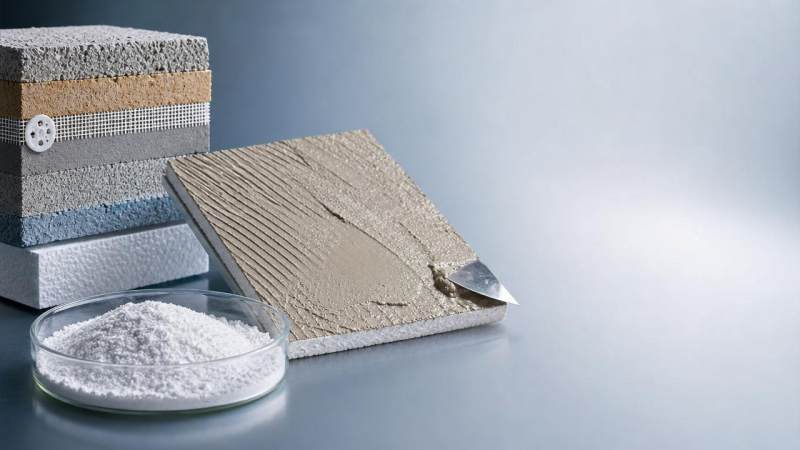
When evaluating REDISPERSIBLE powder for EIFS, the first checks should focus on bonding performance, flexibility, water resistance, and compatibility with the full system.
For technical assessment, early verification of consistency, workability, and aging stability helps reduce coating defects, delamination risk, and long-term maintenance pressure.
In exterior insulation and finish systems, REDISPERSIBLE materials influence adhesion between layers, crack resistance under movement, and finish durability under weather exposure.
Understanding the Role of REDISPERSIBLE Powder in EIFS
EIFS is a multi-layer exterior wall system combining insulation boards, adhesive mortar, base coat, reinforcement mesh, and decorative finish.
Within this structure, REDISPERSIBLE powder acts as a polymer binder modifier after hydration and film formation.
It improves mortar adhesion to EPS, XPS, mineral wool, concrete, and cementitious substrates.
It also supports deformation tolerance, impact behavior, and resistance to moisture penetration.
For chemical system design, the powder cannot be judged only by price or generic grade naming.
The first checks should connect formulation behavior with the actual service conditions of the wall assembly.
Why early screening matters
Poor polymer selection may not fail immediately during mixing or application.
Problems often appear later as hollow spots, edge curling, water whitening, cracking, or reduced bond retention after aging.
That is why REDISPERSIBLE evaluation should start with measurable technical indicators rather than appearance alone.
The First Technical Checks That Deserve Attention
Several indicators provide fast and practical insight before deeper formulation optimization begins.
- Initial and aged adhesion strength
- Flexibility and crack-bridging contribution
- Water resistance and wet adhesion retention
- Compatibility with cement, fillers, cellulose ether, and additives
- Powder consistency, redispersion behavior, and storage stability
- Application feel, open time, and anti-sag performance
Bonding performance comes first
Adhesion is usually the first screening point for EIFS adhesive mortar and base coat formulations.
A suitable REDISPERSIBLE grade should bond well to both insulation boards and mineral substrates.
Check dry adhesion, heat-aged adhesion, water-immersed adhesion, and freeze-thaw retention if relevant to climate exposure.
Flexibility reduces cracking pressure
EIFS layers move under thermal cycling, wind load, and substrate shrinkage.
The polymer contribution should help the mortar absorb stress without becoming too soft or weak.
Good balance matters more than maximum flexibility alone.
Water resistance must be verified early
Exterior systems face rain, humidity, condensation, and seasonal temperature swings.
A REDISPERSIBLE powder with weak water resistance may lose bond strength or show surface whitening after exposure.
This is especially important in coastal, cold, or long-rain regions.
Key Industry Signals Behind Material Selection
Current EIFS formulations are influenced by energy-saving regulations, climate durability targets, and demand for stable dry-mix construction performance.
In this context, REDISPERSIBLE powder is no longer a simple additive.
It is a core functional component in balancing construction ease and long-term wall reliability.
A company with integrated cellulose ether and polymer expertise can often support better formulation matching.
Jinan Ludong Chemical Co., Ltd. focuses on cellulose ethers and construction additives, including HPMC, HPS, and polymer solutions for dry-mix systems.
Its large-scale production, automated lines, and broad viscosity control support more consistent raw material performance across batches.
Practical Value of Proper REDISPERSIBLE Selection
The right material choice improves both lab results and field outcomes.
In EIFS, this means more than stronger bonding.
- More stable troweling and spreading behavior
- Improved mesh embedding in base coats
- Lower tendency toward brittle cracking
- Better resistance to moisture-related failures
- Reduced formulation adjustment during seasonal shifts
These benefits directly affect finish appearance, repair frequency, and service life.
Where project quality depends on layered material interaction, polymer stability becomes a strategic factor.
A useful reference point can be Redispersible Polymer Powder, especially when comparing bond strength, workability, and resistance properties within EIFS mortar systems.
Typical EIFS Scenarios and What to Prioritize
Not every EIFS formulation faces the same stress profile.
The first check priorities should reflect insulation type, climate, and layer function.
This scenario-based approach makes REDISPERSIBLE selection more reliable than depending on general-purpose claims.
Practical Checks Before Final Approval
Before approval, combine lab data with small-batch formulation trials and simulated application checks.
- Review technical data for ash content, minimum film-forming behavior, bulk density, and protective colloid profile.
- Test compatibility with cement type, calcium fillers, cellulose ether, defoamer, and hydrophobic agents.
- Compare dry and wet adhesion under the same curing conditions.
- Observe mixing time, lump formation, and mortar smoothness.
- Check crack tendency after curing and after environmental cycling.
- Verify storage stability under realistic warehouse humidity conditions.
If the powder performs well only in isolated tests, it may still fail in a complete EIFS system.
System compatibility is the final filter.
For that reason, many formulations benefit from comparing more than one Redispersible Polymer Powder option under identical conditions.
Next-Step Guidance for Better EIFS Evaluation
The first thing to check in REDISPERSIBLE powder for EIFS is not a single number.
It is the balance between bonding, flexibility, water resistance, and system compatibility.
A disciplined screening process can reduce reformulation cycles and improve façade reliability over time.
Start with target application conditions, confirm key performance retention, and validate the full dry-mix interaction before scale-up.
That approach gives REDISPERSIBLE selection real technical value, not just material substitution.
Send Your Inquiry
We welcome your cooperation and we will develop with you.
