


Reducing Rework with the Right MHEC Grade
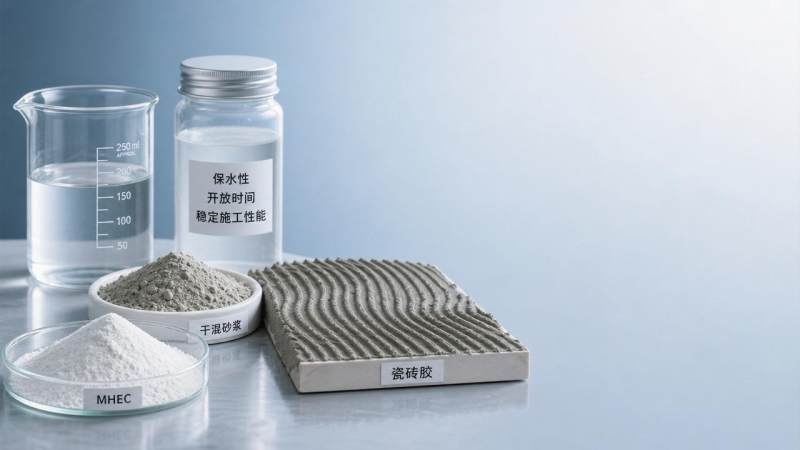
Rework can quietly drain budgets, delay handovers, and damage project margins—especially when mortar, tile adhesives, or renders fail to perform consistently on site.
Choosing the right Methyl Hydroxyethyl Cellulose (MHEC) grade helps improve workability, water retention, open time, and adhesion stability across demanding construction applications.
For tight schedules and strict quality expectations, understanding Methyl Hydroxyethyl Cellulose (MHEC) selection is a practical step toward fewer defects and predictable outcomes.
What does Methyl Hydroxyethyl Cellulose (MHEC) do in construction chemicals?
Methyl Hydroxyethyl Cellulose (MHEC) is a non-ionic cellulose ether used to modify cement-based and gypsum-based dry-mix materials.
Its main role is not only thickening. It also controls water movement, improves slip resistance, and supports smoother application behavior.
In tile adhesive, Methyl Hydroxyethyl Cellulose (MHEC) helps maintain workable consistency after mixing, brushing, and troweling.
In wall putty, skim coat, render, and masonry mortar, it reduces fast water loss into porous substrates.
This matters because cement hydration needs enough retained water to develop strength and bonding reliability.
When the wrong Methyl Hydroxyethyl Cellulose (MHEC) grade is selected, materials may feel good initially but fail during placement or curing.
Common symptoms include dragging, poor wetting, sagging tiles, weak adhesion, surface cracking, or short open time.
These failures often trigger patching, removal, retesting, and labor-intensive reapplication.
Why is grade selection different from simple dosage adjustment?
Increasing dosage cannot always correct a mismatched grade. It may raise viscosity while worsening spreadability or delaying strength development.
A suitable Methyl Hydroxyethyl Cellulose (MHEC) grade balances viscosity, substitution pattern, particle behavior, and application demand.
That balance is what helps dry-mix formulations perform consistently under different temperatures, substrates, and mixing habits.
How does the right Methyl Hydroxyethyl Cellulose (MHEC) grade reduce rework?
Rework usually begins with small inconsistencies. A mortar is slightly too dry, a tile slips, or a render loses water too fast.
The right Methyl Hydroxyethyl Cellulose (MHEC) grade reduces these inconsistencies before they become visible defects.
- Better water retention supports cement hydration and adhesion development.
- Stable viscosity improves application feel across repeated batches.
- Longer open time gives more placement tolerance.
- Improved anti-sag performance reduces tile movement and surface deformation.
- Controlled workability reduces fatigue and irregular application pressure.
These effects reduce the chance of scraping off material, replacing tiles, repairing hollow spots, or correcting uneven finishes.
They also improve acceptance during internal inspection and final delivery.
In advanced formulations, Methyl Hydroxyethyl Cellulose (MHEC) may work with redispersible polymer powder, starch ether, defoamers, and setting modifiers.
Some systems also use Polyvinyl Alcohol where film-forming or bonding characteristics are required.
The key is compatibility. A strong additive package still needs the correct cellulose ether foundation.
Which performance indicators should guide Methyl Hydroxyethyl Cellulose (MHEC) selection?
A useful selection process starts with performance indicators, not only product names or viscosity numbers.
Methyl Hydroxyethyl Cellulose (MHEC) grades may share similar stated viscosity yet behave differently in real mortar.
Water retention
Water retention is critical for tile adhesive, plaster, render, and wall putty applied over absorbent surfaces.
Low retention can cause early drying, weak hydration, poor bond, and powdery surfaces.
A proper Methyl Hydroxyethyl Cellulose (MHEC) grade protects moisture without making the material sticky or difficult to finish.
Viscosity and rheology
Viscosity affects consistency, but rheology explains how the material behaves during mixing, troweling, resting, and vertical placement.
For tile adhesive, the grade should offer smooth combing and enough standing power after ridges are formed.
For skim coat, the grade should allow easy spreading, good leveling, and minimal roller or trowel marks.
Open time and adjustment time
Open time is essential where large areas, warm climates, or complex tile placement slow the application process.
Methyl Hydroxyethyl Cellulose (MHEC) helps keep the adhesive surface active for bonding after troweling.
If open time is too short, tiles may seem attached but later show hollowing or reduced pull-off strength.
Compatibility with cement and additives
Cement type, filler grading, polymer content, and retarders influence how Methyl Hydroxyethyl Cellulose (MHEC) performs.
Laboratory screening should include the actual formula, not only water solution viscosity.
How should different applications match different Methyl Hydroxyethyl Cellulose (MHEC) grades?
Different construction chemicals require different balances. One universal Methyl Hydroxyethyl Cellulose (MHEC) grade rarely fits every application.
For tile adhesive, Methyl Hydroxyethyl Cellulose (MHEC) should prevent sudden water loss while keeping ridges stable.
For putty, excessive viscosity may feel rich but can reduce efficiency and create finishing marks.
For render, insufficient water retention may cause shrinkage cracks and lower surface strength.
For gypsum systems, compatibility with setting behavior must be checked carefully before scaling production.
What mistakes cause poor results even with Methyl Hydroxyethyl Cellulose (MHEC)?
Using Methyl Hydroxyethyl Cellulose (MHEC) does not automatically prevent rework. Several mistakes can reduce its effectiveness.
- Selecting only by viscosity instead of application performance.
- Testing in clean water but not in the final dry-mix formula.
- Ignoring cement quality, filler absorption, and local climate.
- Overdosing to solve one issue while creating stickiness or slow setting.
- Changing raw materials without checking cellulose ether response.
Another frequent mistake is overlooking mixing conditions. Poor dispersion may form lumps or uneven viscosity development.
Dry blending order, powder uniformity, water temperature, and mixing time all influence field performance.
A correct Methyl Hydroxyethyl Cellulose (MHEC) grade still needs consistent processing and quality control.
How can testing reduce the risk of rework?
Testing should reflect real use. Bench tests, pilot batches, and site trials each reveal different information.
Useful checks include water retention, wet density, sag resistance, open time, adhesion strength, and application feel.
Comparing Methyl Hydroxyethyl Cellulose (MHEC) grades under the same formula helps avoid misleading conclusions.
When performance differences are small in the lab, outdoor temperature and substrate absorption may reveal the better option.
How should cost be evaluated when choosing Methyl Hydroxyethyl Cellulose (MHEC)?
The cheapest grade is not always the lowest-cost choice. Rework, complaints, delays, and wasted material change the real calculation.
A suitable Methyl Hydroxyethyl Cellulose (MHEC) grade may reduce total cost by improving first-pass quality.
Cost evaluation should include dosage efficiency, batch stability, climate tolerance, and the cost of defect correction.
This approach connects material cost with process reliability, not only purchase price.
In many formulas, the best Methyl Hydroxyethyl Cellulose (MHEC) grade is the one that protects performance at a stable dosage.
What should be expected from a reliable cellulose ether supplier?
Reliable supply matters because construction chemical formulas depend on repeatable raw material behavior.
Jinan Ludong Chemical Co., Ltd. focuses on cellulose ethers and integrated construction chemical solutions for global applications.
Established in 2020, the company operates advanced production lines combining traditional processes with intelligent automated production.
Its main products include HPMC, RDP, and HPS, supporting applications such as mortar, tile adhesive, putty, and other dry-mix systems.
Annual production capacity reaches 45,000 tons, with HPMC series viscosities controllable from 400 to 200,000 CPS.
For projects considering Methyl Hydroxyethyl Cellulose (MHEC), this manufacturing background supports formulation discussion, grade comparison, and consistent delivery planning.
A capable supplier should help connect laboratory values with real construction performance.
Technical communication should cover water retention targets, application climate, base material, polymer use, and expected setting behavior.
Where formulas involve film-forming support, Polyvinyl Alcohol may also be reviewed within the broader additive system.
FAQ: practical questions about Methyl Hydroxyethyl Cellulose (MHEC)
Is higher viscosity always better?
No. Higher viscosity may improve standing power, but it can reduce spreadability and increase application resistance.
The best Methyl Hydroxyethyl Cellulose (MHEC) grade depends on the formula target and application method.
Can one grade work for tile adhesive and wall putty?
Sometimes, but it should not be assumed. Tile adhesive needs open time, anti-sag, and bonding support.
Wall putty usually prioritizes smooth spreading, surface finish, and sanding behavior.
What causes sudden site complaints after stable production?
Changes in cement, sand grading, temperature, substrate absorption, or mixing water can alter performance.
Reviewing the Methyl Hydroxyethyl Cellulose (MHEC) grade together with changed raw materials is important.
How long should grade validation take?
Initial lab screening can be quick, but reliable validation should include curing, adhesion, and application trials.
For critical projects, testing under local site conditions gives stronger decision confidence.
Conclusion: turn Methyl Hydroxyethyl Cellulose (MHEC) selection into quality control
Reducing rework starts before the material reaches the wall, floor, or façade.
The right Methyl Hydroxyethyl Cellulose (MHEC) grade improves water retention, workability, open time, and application stability.
It also helps dry-mix construction chemicals perform consistently despite real site variation.
To make a better selection, define the application, test the full formula, compare grades under realistic conditions, and confirm dosage efficiency.
When grade selection becomes part of quality planning, rework becomes easier to prevent, not only repair.
Send Your Inquiry
We welcome your cooperation and we will develop with you.
