


What Affects Polyvinyl Alcohol Dissolution Time in Production
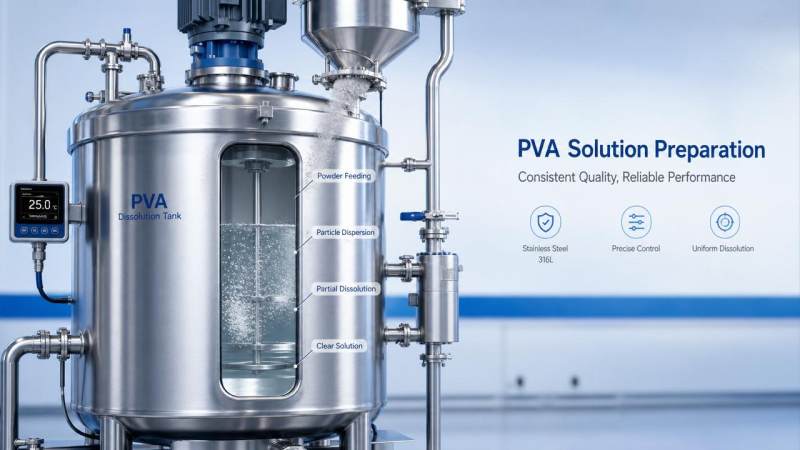
In production planning, Polyvinyl Alcohol dissolution time affects batch rhythm, mixing efficiency, product consistency, and delivery reliability. A slow or unstable dissolving step can create gel particles, increase energy use, and delay downstream operations. Understanding what changes Polyvinyl Alcohol behavior helps improve process control and reduce avoidable waste.
In chemical production, dissolution is not controlled by one variable alone. Water temperature, polymer grade, particle size, pH, agitation intensity, dosing method, and holding time all matter. When these factors are balanced, Polyvinyl Alcohol dissolves more predictably and supports stable product quality.
What does Polyvinyl Alcohol dissolution time actually mean?
Polyvinyl Alcohol dissolution time is the period needed for the material to fully hydrate, disperse, and form a clear or uniform solution under defined conditions. It is not only about disappearance of visible powder.
A batch may look mixed while still containing fish eyes, undissolved cores, or localized viscosity differences. These hidden defects can affect coating performance, adhesive strength, film quality, or blending stability.
For this reason, dissolution time should be measured against practical standards, such as clarity, viscosity uniformity, filtration residue, or screen passing rate. Using one clear benchmark improves repeatability across shifts.
Why is this important in production?
- It determines how fast a batch can move to the next process.
- It influences viscosity development and final product uniformity.
- It affects steam, electricity, and labor consumption.
- It reduces rework caused by undissolved Polyvinyl Alcohol particles.
How does water temperature affect Polyvinyl Alcohol dissolution time?
Water temperature is often the most influential variable in Polyvinyl Alcohol dissolution. Different grades respond differently, but low temperature usually slows hydration, swelling, and chain mobility.
If temperature is too low, Polyvinyl Alcohol may disperse without dissolving fully. If temperature is too high too early, powder surfaces can agglomerate and trap dry material inside.
A staged process is often more effective. First, disperse Polyvinyl Alcohol into controlled water under agitation. Then raise temperature gradually until the target dissolution range is reached.
Common temperature-related issues
- Cold water extends dissolution time and may leave suspended particles.
- Rapid heating can create clumps with dry centers.
- Uneven tank heating causes inconsistent Polyvinyl Alcohol performance.
- Poor temperature recording makes troubleshooting difficult.
The best approach is to define a temperature profile, not just a final temperature. This gives better control over dissolution time and reduces variation between batches.
Which material properties change Polyvinyl Alcohol dissolution behavior?
Not all Polyvinyl Alcohol grades dissolve at the same speed. Degree of hydrolysis, molecular weight, viscosity range, and particle size strongly affect hydration and solubility.
A higher degree of hydrolysis often improves certain end-use properties, but it may also require more heat or longer time to dissolve. Higher molecular weight grades also tend to increase solution viscosity faster.
Particle size matters as well. Fine powder has more surface area and can hydrate quickly, but it may also form lumps if added too fast. Coarser particles feed more easily, yet may need longer mixing.
What should be checked when selecting a grade?
- Degree of hydrolysis and recommended dissolving temperature.
- Viscosity target in final concentration.
- Particle size distribution and feeding behavior.
- Compatibility with salts, fillers, and additives.
In some compound systems, auxiliary thickeners or water-retention agents are also used. One relevant material in formulated systems is Methyl Hydroxyethyl Cellulose (HEMC), especially where rheology balance is required.
How do agitation, feeding method, and concentration influence dissolution time?
Agitation does more than move liquid. It controls wetting efficiency, powder distribution, heat transfer, and lump prevention. Weak mixing often leaves floating powder. Overly aggressive mixing can pull air into the batch.
Feeding method is equally important. Adding Polyvinyl Alcohol too quickly can overload the liquid surface and create agglomerates. Controlled, steady dosing usually shortens effective dissolution time.
Concentration also changes behavior. As the solution thickens, circulation slows and local mass transfer becomes harder. High-solids preparation often needs longer time or a different mixing sequence.
Practical ways to improve this step
- Create a vortex appropriate for wetting, not excessive air entrainment.
- Use gradual powder feeding instead of one-time dumping.
- Pre-blend dry materials when the formula allows it.
- Adjust batch concentration to match equipment capability.
If repeated lumping occurs, the root cause is often process design rather than raw material quality alone. Equipment geometry, impeller type, and dosing point should be reviewed together.
What process conditions are often overlooked?
Several hidden variables can change Polyvinyl Alcohol dissolution time. Water quality is a common one. High hardness, dissolved salts, or contaminants may alter hydration and clarity.
pH can also influence overall system behavior, especially in multi-component formulations. While Polyvinyl Alcohol is generally stable, surrounding chemicals may change solution performance during heating and holding.
Tank dead zones are another issue. Material trapped in low-flow areas dissolves slowly and later releases into the batch as gel specks. This problem often appears as random quality fluctuation.
Other frequently missed factors
- Residence time after full temperature is reached.
- Order of addition with pigments, fillers, or surfactants.
- Seasonal temperature swings in plant water supply.
- Instrument accuracy for temperature and agitation speed.
In some formulations, combining Polyvinyl Alcohol with cellulose ether systems can support processing stability. A related option is Methyl Hydroxyethyl Cellulose (HEMC) where water retention and workability need adjustment.
How can dissolution time be reduced without creating quality risks?
The fastest process is not always the best process. Reducing Polyvinyl Alcohol dissolution time should not sacrifice clarity, viscosity stability, or final application performance.
A controlled optimization program works better than isolated changes. Adjust one variable at a time and record solution appearance, final viscosity, filtration residue, and energy input.
Recommended optimization sequence
- Confirm the exact Polyvinyl Alcohol grade specification.
- Set a fixed water temperature starting point.
- Standardize feeding speed and dosing location.
- Review impeller design and circulation pattern.
- Validate concentration and hold time at scale.
This method helps identify whether the main limit comes from chemistry, equipment, or operating discipline. It also supports easier scale-up from trial batches to routine production.
Quick FAQ table: what should be checked first?
Polyvinyl Alcohol dissolution time is shaped by the interaction of temperature, grade selection, feeding method, agitation, concentration, and hidden plant conditions. Better control comes from treating dissolution as a defined process, not a simple mixing step.
Jinan Ludong Chemical Co., Ltd. supports global chemical and construction solution needs through advanced production lines, integrated services, and stable quality management. For more predictable formulation performance, review your current dissolving procedure and compare it against material specifications, equipment capability, and batch records.
Send Your Inquiry
We welcome your cooperation and we will develop with you.
