


What to Ask Before Choosing a Hydroxypropyl Methyl Cellulose Supplier
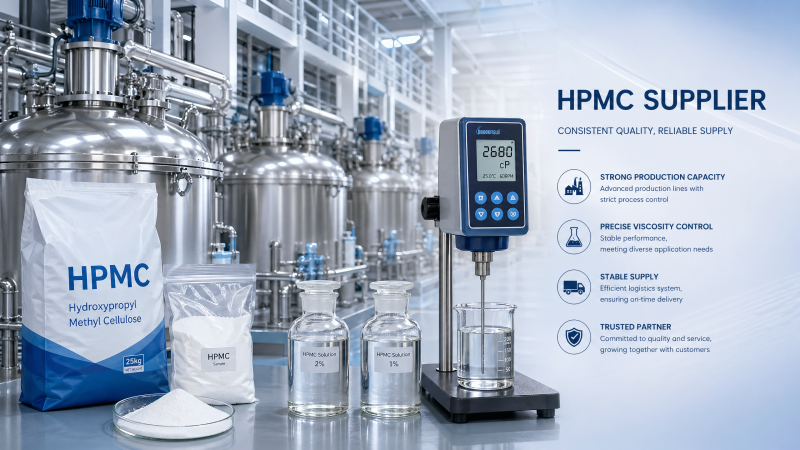
Choosing the right HYDROXYPROPYL METHYL CELLULOSE supplier can directly affect product quality, supply stability, and long-term procurement costs. For buyers in the chemical and construction sectors, asking the right questions before making a decision is essential. From production capacity and viscosity control to technical support and global delivery, this guide highlights the key factors you should evaluate to select a reliable partner.
Why does supplier selection matter so much in HPMC procurement?
For procurement teams, HPMC is not a simple commodity purchase. In construction drymix mortar, tile adhesive, skim coat, EIFS, gypsum-based materials, and some chemical formulations, even a small shift in viscosity, water retention, or workability can change production results. That is why a HYDROXYPROPYL METHYL CELLULOSE supplier should be evaluated not only on price per ton, but also on batch consistency, technical response speed, and realistic lead times.
A weak supplier relationship often creates 3 direct risks: unstable formulation performance, delayed replenishment, and hidden total cost. Buyers may save on the initial quote, yet lose more through reformulation time, customer complaints, or interrupted project schedules. In chemical procurement, the true cost is measured over 6–12 months, not only at the moment a purchase order is issued.
This is especially relevant when you source from global markets where order quantities can range from trial samples to container-level shipments. A supplier that can support viscosities from 400 to 200,000 CPS, explain grade selection clearly, and coordinate shipment windows within typical 7–15 day or 2–4 week planning cycles is often more valuable than one that only offers a short-term discount.
Jinan Ludong Chemical Co., Ltd. operates in this context as a large-scale enterprise focused on cellulose ethers production, trading, and integrated services. With annual production capacity reaching 45,000 tons and HPMC series including type 75 and type 60 for construction and chemical grades, it is positioned to support buyers who need both volume assurance and flexible specification control.
What procurement teams should clarify first
- Whether the required application is construction grade, chemical grade, or a formulation-specific grade with defined viscosity and retention expectations.
- Whether the supplier can maintain batch-to-batch consistency over repeated monthly or quarterly orders.
- Whether technical support includes sample evaluation, application recommendations, and troubleshooting after delivery.
- Whether logistics planning matches your replenishment rhythm, storage conditions, and import documentation requirements.
What questions should you ask a HYDROXYPROPYL METHYL CELLULOSE supplier about production capability?
Production capability is the first filter because it determines whether a supplier can support your procurement plan during both normal purchasing cycles and peak demand periods. Buyers should ask about annual capacity, core product range, stable output by grade, and how the factory balances large-volume orders with urgent smaller shipments. This matters when your demand shifts from pilot use to regular production in 3 stages: sampling, validation, and scaled supply.
It is also important to ask whether production relies only on manual process control or combines traditional process experience with intelligent automation. In cellulose ether manufacturing, automated control can help reduce avoidable variation in viscosity range, moisture condition, and production repeatability. Ludong Chemical emphasizes this fusion of traditional processes and intelligent automated production, which is highly relevant for buyers seeking consistency rather than one-off supply.
A practical question is this: can the supplier support the exact grade range your formulation needs today and the adjacent range you may need 3–6 months later? If your current specification is one viscosity level but your R&D team may adjust mortar open time or anti-sag performance, your supplier should be able to respond without restarting the sourcing process from zero.
Another smart question concerns contingency capacity. Procurement teams should ask how the supplier handles raw material fluctuations, maintenance downtime, and priority scheduling. A qualified partner will explain lead time windows, order reservation practice, and communication procedures when delivery risk appears.
A short checklist for factory capability review
Before moving to price negotiation, use the following matrix to compare supply reliability factors. It helps procurement teams avoid making decisions based on quotation alone.
This type of comparison quickly reveals which HYDROXYPROPYL METHYL CELLULOSE supplier can act as a stable sourcing partner. Capacity, range, and scheduling transparency usually indicate whether the supplier can support a strategic account rather than just a single order.
Which technical parameters should buyers verify before approval?
Technical matching is often where purchasing and application teams need stronger alignment. Buyers should not approve HPMC based only on a generic product name. They should ask for viscosity range, application grade, recommended use scenarios, moisture-related handling guidance, and any available test methods used for batch control. In many projects, 4 key indicators drive the discussion: viscosity, water retention behavior, workability effect, and consistency between lots.
For example, if you are buying for tile adhesive or plaster systems, the selected grade must support the target construction performance. A viscosity mismatch may affect anti-slip behavior, open time, and ease of mixing. Buyers should ask suppliers to explain not just the number, but the practical effect of selecting one viscosity band over another. Ludong Chemical’s HPMC viscosity control from 400 to 200,000 CPS is meaningful because it gives room for more precise application matching across different formulations.
You should also ask how the supplier supports trial testing. In many B2B procurement cycles, validation takes 1–3 rounds of lab or production tests before final approval. A supplier that can recommend a starting grade, provide sample support, and discuss adjustment logic will save time for both procurement and technical departments.
In some sourcing conversations, buyers may also review adjacent cellulose ether options depending on the end-use system. For broader formulation planning, it can be useful to discuss related materials such as Methyl Hydroxyethyl Cellulose (HEMC) when comparing water retention, temperature tolerance, or system compatibility in selected applications.
How to compare technical suitability by application
The table below helps procurement staff speak the same language as technical teams when reviewing whether a proposed HPMC grade fits the intended use.
This approach makes supplier discussions more practical. Instead of asking for a “good” product, the buyer asks for a product that matches a specific scenario, performance target, and validation process.
A useful 4-step sample validation routine
- Request 1–2 candidate grades based on your application and current benchmark formula.
- Run lab-scale comparison on viscosity behavior, workability, and water retention effect.
- Confirm performance in small production batches before committing to regular procurement.
- Approve a commercial grade only after aligning technical results with lead time and pricing terms.
How should buyers assess cost, service, and delivery instead of price alone?
When comparing suppliers, price is important, but it is only 1 part of total procurement cost. Buyers should calculate the broader cost picture over at least 4 dimensions: unit price, consumption efficiency in the formula, failure or rework risk, and supply continuity. A lower quotation can become more expensive if the product requires dosage adjustment or causes unstable processing.
Ask your HYDROXYPROPYL METHYL CELLULOSE supplier how they manage sample requests, quotation updates, order confirmation, production scheduling, and shipping communication. A supplier with a clear service process often helps purchasing departments reduce internal coordination time. This matters when procurement teams must manage multiple SKUs, quality approvals, and delivery targets within monthly purchasing cycles.
Delivery capability should also be discussed in realistic terms. Ask about typical sample dispatch timing, standard order lead time, export packaging options, and how shipment status is updated. For international buyers, document accuracy, packaging durability, and communication speed can influence customs clearance and warehouse planning as much as the material itself.
For suppliers serving global construction solution markets, integrated capability is a major advantage. Ludong Chemical not only supplies HPMC, but also related products such as RDP and HPS. For buyers managing combined drymix systems, this can simplify supplier management and create stronger technical coordination across the formulation package.
Questions that reveal the real total cost
- What is the normal lead time for samples, repeat orders, and container shipments?
- Can the supplier maintain price validity for a defined period such as 15–30 days during approval and budgeting?
- What packaging options are available for warehousing, inland transport, and export handling?
- How are complaints, lot questions, or urgent replenishment requests handled after shipment?
What often separates strategic suppliers from transactional ones
Transactional suppliers mainly respond to immediate inquiries. Strategic suppliers help buyers reduce decision risk. They can discuss specification logic, likely delivery windows, substitute options inside the same product family, and the impact of formulation adjustments. That kind of support is especially valuable when procurement works under budget pressure but cannot accept project delays or unstable field performance.
If your sourcing plan includes multiple cellulose ether solutions, it may also be practical to review adjacent grades such as Methyl Hydroxyethyl Cellulose (HEMC) for comparison in selected systems. This does not replace HPMC selection, but it helps buyers and technical teams evaluate broader formulation flexibility before locking in annual procurement plans.
What compliance, documentation, and risk questions should never be skipped?
In chemical sourcing, documentation review is part of risk control. Buyers should ask what standard product documents are available, what technical data can be provided, and how lot-level traceability is handled. Even when no special regulatory framework is requested, routine procurement usually requires at least 3 categories of documentation: product specification information, safety-related documentation where applicable, and shipment-related commercial documents.
It is equally important to clarify storage and handling recommendations. Cellulose ethers are sensitive to packaging integrity and storage conditions in practical supply chains. Ask about shelf-life guidance, moisture protection expectations, palletizing practice, and warehouse rotation recommendations. A supplier that discusses these details proactively usually understands downstream risk, not just factory output.
Buyers should also ask how quality issues are investigated. If a lot appears different during production, what is the response path? Who reviews the batch information? How quickly can technical and commercial teams coordinate? In many B2B purchasing systems, response time within 24–72 hours for initial feedback is a reasonable topic to clarify before the first large order.
These questions are not signs of distrust. They are standard procurement discipline. A reliable HYDROXYPROPYL METHYL CELLULOSE supplier should welcome them because transparency reduces friction on both sides and supports smoother long-term cooperation.
Common mistakes procurement teams should avoid
Mistake 1: Buying only by nominal viscosity
A viscosity label is important, but it does not fully describe application behavior. Buyers should confirm how the grade performs in the actual target system and whether formulation testing is needed before scale-up.
Mistake 2: Ignoring future volume growth
A supplier that can support trial quantities may not always support larger monthly demand. Ask early whether the same grade remains available when your volume moves from test orders to stable production demand.
Mistake 3: Treating support service as optional
In practice, service quality affects procurement efficiency. Technical clarification, document responsiveness, and delivery visibility can save days of internal follow-up and reduce launch risk.
FAQ: what do buyers most often ask before choosing a supplier?
How do I compare two HPMC suppliers fairly?
Use a 5-point comparison: specification fit, sample performance, batch consistency, lead time reliability, and total cost. If one supplier is slightly cheaper but slower to respond, has a narrower viscosity range, or provides weak support during testing, the apparent price advantage may disappear after 1–2 production cycles.
What lead time should I expect for regular HPMC procurement?
Lead times vary by order size, grade complexity, and destination. For procurement planning, buyers often discuss samples separately from commercial orders and should confirm whether the timeline is measured from inquiry, confirmation, or payment milestone. It is best to ask for normal lead time and urgent-case lead time, then align this with your safety stock policy.
What should I request during sample evaluation?
Request a clear product recommendation, basic technical specification, application advice, and guidance on how the candidate grade differs from your current material. Then validate through 2 steps: laboratory screening and small production verification. This reduces the risk of approving a grade that looks acceptable on paper but fails in practical use.
Can one supplier support multiple cellulose ether needs?
Yes, and that can be a procurement advantage if your business uses a broader portfolio. A supplier that offers HPMC together with related products such as RDP and HPS may simplify sourcing, reduce vendor coordination time, and improve technical matching across a full drymix or construction chemical system.
Why choose us when evaluating long-term HPMC supply?
For procurement teams looking for a dependable HYDROXYPROPYL METHYL CELLULOSE supplier, the key value is not a single claim. It is the combination of manufacturing scale, product range, process control, and service coordination. Jinan Ludong Chemical Co., Ltd. focuses on cellulose ethers production, trading, and integrated services, with annual capacity of 45,000 tons and HPMC viscosity control from 400 to 200,000 CPS to support different construction and chemical applications.
This capability matters when your team needs more than one answer. You may need help with parameter confirmation, grade selection, sample comparison, delivery planning, or coordination across HPMC, RDP, and HPS requirements. A supplier with integrated production lines and flexible manufacturing can usually respond more effectively to both routine sourcing and customized project demands.
If you are currently comparing suppliers, you can contact us to discuss 6 practical items: target application, viscosity range, expected order volume, sample needs, delivery schedule, and documentation requirements. This makes the conversation faster and more useful for both purchasing and technical teams.
Reach out if you want support with product selection, quotation communication, sample arrangement, lead time confirmation, or a broader construction chemical sourcing plan. A careful supplier review today can reduce quality risk, improve supply continuity, and strengthen your procurement position over the next purchasing cycle.
Send Your Inquiry
We welcome your cooperation and we will develop with you.
